

Section 8: Preferred IFR routes (low and high altitude)
Section 9: Air route and airport surveillance RADAR facilities
Various types of air navigation aids are in use today, each serving a special purpose in
the total system. Although they have varied owners, the FAA has the statutory authority
to establish, operate, and maintain a common system of air navigational facilities and to
prescribe standards for the operation of any aids used for IFR flight in controlled
airspace. This common system is referred to as the National Airspace System (NAS).
Knowledge of the basic theory of radio, applicable to both communications and air
navigation equipment, increases your understanding of the uses and limitations of
radios and how they interface within the NAS.
Radio Theory
To understand the information in this section, it is essential to have a basic
understanding of radio theory and the principles involved.
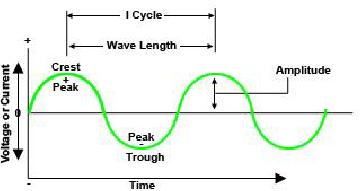
Radiated electromagnetic energy suitable for radio communication is called a Hertzian
wave. This wave can be represented as a sine curve. The top of the wave represents
the maximum positive value, and the bottom represents the maximum negative value
(see Figure 2-9.) Either maximum may be called a peak. Wavelength is the distance
between corresponding points on consecutive waves, or the distance a wave travels
during one cycle. Frequency is the number of cycles that occur per second, stated in
terms of hertz (Hz); the thousands of cycles per second, stated in kilohertz (kHz); the
millions of cycles per second, stated in megahertz (MHz); or the billions of cycles per
seconds, stated in gigahertz (GHz).
Figure 2-9 -- Sine curve.
2-24