

REGULATOR
1234
TO
VEHICLE
R
F
BAT
GND
ALTERNATOR
BATTERY
ASf06040
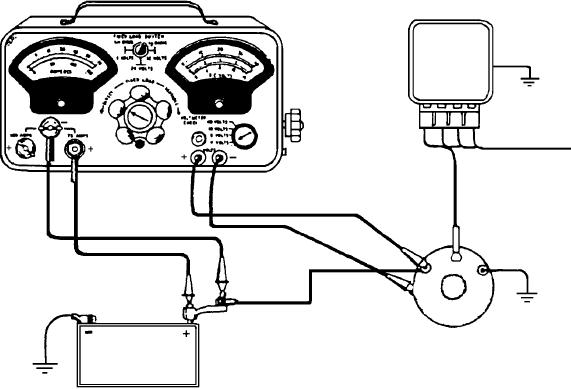
Figure 6-40.--Voltage regulator test.
Q6-17.
What is one purpose of the current regulator?
If the regulator is adjustable, use the voltage
adjustment screw to bring the regulator within the
1. To protect the voltage regulator from an
manufacturers specifications. Regulators that are not
increased input voltage
adjustable, or regulators that cannot be adjusted within
2. To regulate the input voltage of the
the manufacturer's specification, will need to be
generator
replaced.
3. To protect the generator and charging
circuit from overload
Q6-15.
What is the purpose of the reverse current
4. To regulate the voltage regulator from
relay in the three-unit vibrating-contact
decreased input voltage
regulator?
Q6-18.
What is one of the major differences between
1. To prevent the battery from discharging
the voltage regulators for the alternator and
through the generator when the engine is
the dc generator?
not running
2. To prevent the generator from over-
1. The regulator for the alternator has a
charging the battery through the regulator
greater output capability
3. To prevent the collapsed field voltage from
2. The regulator for the dc generator has a
damaging other circuit components
greater output capability
4. To prevent the field voltage from arcing
3. The regulator for the alternator does not
across the contacts of the regulator
require a reverse current relay
4. The regulator for the dc generator does
Q6-16.
The voltage regulator has a series winding of
not require a reverse current relay
many turns of fine wire and is shunted across
the generator. This shunt winding consists of
Q6-19.
The only purpose of the fully transistorized
which of the following characteristics?
regulator is to perform which of the following
functions?
1.
Many turns of fine wire
2.
A few turns of fine wire
1. To control the current output of the
3.
Many turns of heavy wire
alternator
4.
A few turns of heavy wire
2. To control the stator voltage
3. To control the rotor current
4. To control the armature voltage
6-35