

For specific operation and exact position indications
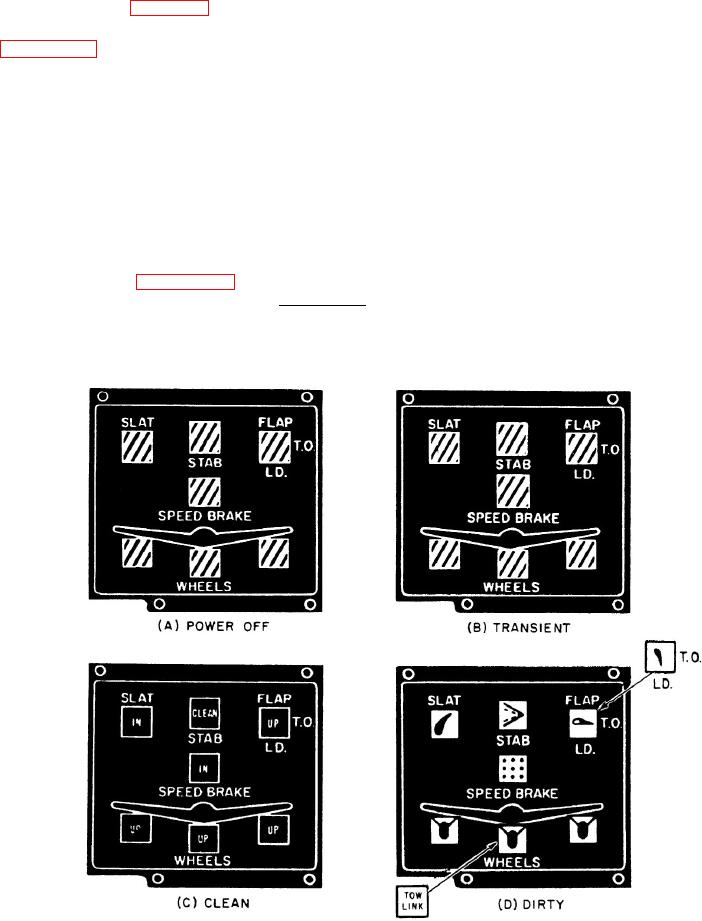
position indicator (IPI) (fig. 6-75). This IPI is from the A-
of these instruments, refer to the MIM for the specific
6A Intruder, all-weather attack aircraft.
aircraft. There are many possible sets of indications.
Figure 6-75 shows the IPI in four different
Briefly, however, slats usually position in conjunction
configurations--power off, transient, clean, and dirty.
with flap movements. The stabilizer shows pitch trim
The power off and transient positions are self-
control (nose up, nose down). The speed brakes, which
explanatory. The term clean describes an aircraft that
are for reducing airspeed, show either as in or out, with
has all of its gear up or in, and the aircraft profile is as
no midposition.
free of parasitic drag as possible. The term dirty means
the opposite of clean--that units are protruding out or
down, and that resulting drags exist. These are not the
only aircraft configurations possible. Most of the
REVIEW SUBSET NUMBER 3
individual systems (stabilizer, flaps, speed brakes, etc.)
are capable of independent action. All the systems do not
Q1. Name the two types of fuel probes.
function simultaneously as shown in the figure.
Views A and B of figure 6-75 show a transitional
period that appears the same as power off--barber poles.
Q2. Upon what does the density of fuel depend?
Figure 6-75.--Integrated position indicator (IPI).
6-66